The Fiber Arts Scavenger Hunt: What We Found at the Tennessee State Museum

We Went to the Museum. We Found Fiber Everywhere.
My girls and I have a tradition. Whenever we visit a museum, we run a fiber arts scavenger hunt. It started as a way to keep them engaged. It turned into something else — a way of seeing that, once developed, doesn’t switch off. In the last few weeks of the school year we took off for an overnight trip from Knoxville to Nashville to visit The Hermitage ( Andrew Jackson’s Home) as well as a few museums most notably the TN State museum.
The Tennessee State Museum surprised us with how much there was to find.
We went for the samplers. The current temporary exhibition is Samplers and Young Women: Threading Together Art and Education, and it deserved its own time. These were pieces of needlework made by girls and young women — not decorative objects, but a technology for learning. They practiced stitching, reading, and writing simultaneously. They signed their names. They recorded family genealogy in thread: names, birthdays, the shape of a life. The exhibit includes samplers from several Tennessee instructors, Locust Grove, Spring Hill, Cloverdale. It was interesting to see the work moved from teacher to student throughout the years. The style of a school, visible in a stitch pattern. This wasn’t the girls first encounter with samplers, we have a few in our home from my mom and her sisters who all shared a love of needle work at one point or another.
We found fiber arts in many places besides just the samplers room.
In the frontier galleries, there’s an interactive display built around a covered wagon. Kids sort wooden tiles — plow, rifle, seeds, chickens, pigs — deciding what a family could carry west. My daughter reached for the spinning wheel tile without hesitation. She knew. It belonged on the wagon because it was vital setting up a new life upon arrival. The spinning wheel in the case nearby was made by John Bedwell in Polk County in 1830. Next to it: cards for combing wool or cotton dating from 1850 to 1900, sheep shears from around 1850, and a sheep bell from the same era. The whole fiber processing chain, right there in a single case.
There was also a set of dress pockets from around 1840 — a garment worn around the waist because women’s skirts had no pockets — and a sewing kit from 1850. Tools and solutions. The work was constant and practical and endless.
Further in, a reproduction of a Cherokee coat from 1820 to 1850 stopped us. Buckskin, fringe, beadwork, embroidery, appliqué. The labor encoded in that garment is staggering. Nearby, a beaded bag made by the Chickasaws in the 1780s and moccasins from 1783 — given by Chickasaw leader Piominko to James Robertson at a conference near present-day Nashville. Fiber as diplomacy. Textile as record.
In the industrial era galleries: a Banner Sock Knitting Machine from around 1913 to 1915, from Englewood in McMinn County quickly became one of my favorite inventions to inspect. The label noted that children frequently operated machines like this one. The photograph behind it showed exactly that.
The art galleries held woven coverlets, a pictorial embroidered textile crowded with figures and animals and YMCA lettering, historic quilts, a rust-toned woven wall hanging. And in the Appalachian Arts section, a wool shawl woven in the 1930s by Louanna Bays Rorex of Blount County — a widow during the Depression who found employment at the Pi Beta Phi Settlement School in Gatlinburg, weaving craft products, eventually becoming an instructor there. One shawl, one woman’s entire trajectory.
If you’d like to see it for yourself The Samplers and Young Women exhibit runs through August 16, 2026. The Tennessee State Museum is free and open to the public in Nashville. We sure had a great time and I hope this inspires you to go on a fiber arts scavenger hunt of your own next time you are at a museum. It’s fascinating to see all of the different times and places fiber arts innovation can be found.
Visiting Sampler Exhibit at the TN State Museum


Fiber arts throughout TN state history


A few fiber arts tools and mentions at Andrew Jacksons Hermitage


Welcome to The Hand Spun Yarn Club!
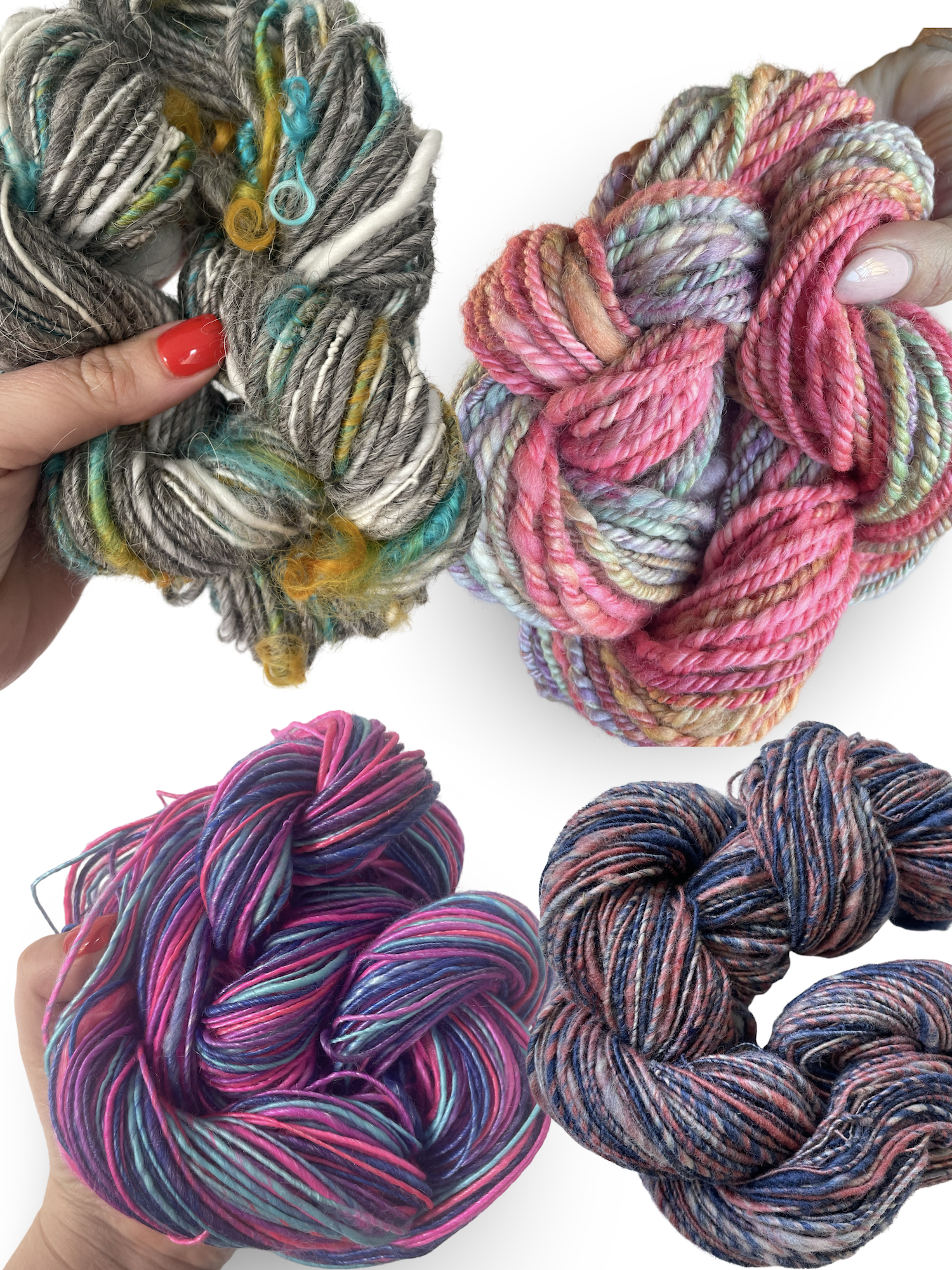
We’ve got some exciting news! Our Yarn Club has expanded, and it’s better than ever. It’s become a favorite for gifting – whether to a loved one or yourself – and we’ve taken your feedback to heart. You asked for a wider variety of colors and textures, and we’ve delivered!
Here’s the scoop:
Monthly Mystery Box: Sign up for our subscription and receive a delightful surprise in your mailbox every month. Each box includes 3-4oz of hand spun yarn, with yardage and gauge varying to highlight the unique qualities of each fiber. Perfect for knitters, crocheters, and weavers!
Simple Subscription: You’ll be billed once a month and receive your box shortly after. Enjoy total flexibility – you can cancel anytime without hassle. If you need to skip a month, just let us know within three days of the charge, and we’ll happily issue a refund.
Share Your Creations: We love seeing what you make with our yarn! Share your projects on Instagram or in our Facebook group, and connect with a community of fellow fiber arts enthusiasts.
All wool sourced from USA farms and mills, hand-spun by local artists, embodies the essence of American craftsmanship and sustainability.
Our curated selection celebrates the vibrant tapestry of regional differences, showcasing not just the rich texture of the wool but also the unique character and creativity of each artisan. When you choose our hand-spun wool, you're supporting small businesses and artists who pour their passion and skill into every strand. Experience the warmth and authenticity that comes from fibers crafted with love and care, and revel in the knowledge that your yarn choices are as local as they are luxurious.
Join the fun and add a touch of mystery to your crafting. Our Yarn Club is designed to inspire and excite – every single month.
Subscribe now and start your yarn adventure today!
We can’t wait to see what you create!

Pollywog: a compact wheel to learn and grow with
The Pollywog was my first SpinOlution wheel and sparked my love of spinning. Its toe treadling, adjustable uptake and small footprint make it a practical starting point, with optional upgrades as your yarn interests change.
Compare Pollywog, King Bee and Bullfrog.
Buy with dealer support. Wheel purchases include personal setup guidance from authorized dealer Erin James, complimentary beginner spinning course enrollment and an emailed coupon for a free braid. Request 4- or 6-week layaway; production begins after the final payment. Confirm your setup, shipping and current delivery estimate with Erin.
This listing is the $495 wheel with a 4 oz flyer and three bobbins. A complete 12 oz wheel is available by request for $695; contact Erin for that configuration.
Current specifications
8.5 lb; height 20.75 in; orifice 19.25 in; width 15 in; depth 9 in. Standard 4 oz setup: six speeds, 2.5:1–14.5:1. The 12 oz setup has six speeds, 2.5:1–14:1.
Optional upgrades
Accelerator: $195; 18 speeds, 2.5:1–43.5:1
Orifice riser: $49; adds 3 inches; not recommended with accelerator
Ordering from Feral Scene
USA wheel orders under $1,800: $25 shipping. Qualifying orders over $1,800 ship free to the lower 48 states. Contact Erin for other destinations or orders totaling exactly $1,800. Confirm current production and delivery timing before ordering. Standard Feral Scene coupons do not apply to SpinOlution.
Photos may show optional engraving or accessories. Wood grain, patches and design details can vary. Dealer benefits and layaway · Ask Erin about your setup
2026 USD pricing and specifications checked against SpinOlution’s current product information, October 19, 2026.